Pages

Showing posts with label Inner Harbor. Show all posts

Wednesday, January 1, 2014

Lackey Island: Baltimore Harbor's Only Island

  During a short period in the Spring of 1910, the Baltimore Harbor and Basin would have its only island appear as a rather prominent geographical feature only to disappear from existence a few months later.   It would be a real life instantiation of the fictitious Devon Island author James Michener wrote of in his famous book Chesapeake.

Baltimore Harbor, 1901
(William Flamm map)
  Dubbed as Lackey Island, it was located off shore in the Harbor Basin immediately to the east of Hughes Street (now Key Highway) and directly south and opposite  from the Union Dock (now Pier 6).  As reported by the Baltimore Sun, it was created as a result of dredging machines cutting away about an acre or so of land from the triangular point occupied by the original Old Bay Line, now only a memory.

  The island's namesake is owed to the Chief Engineer of the Harbor Board at the time, Oscar F. Lackey, who designed the bulkheads of these three piers in the Baltimore Inner Harbor.  From earliest geographic history, prior to this design, there was a peninsula that existed connecting from the present Piers 5 and 6 and extending in a southeast direction (refer to the 1901 map, left) which made for a rather narrow and precarious passage for most ships entering the Basin.

Baltimore Harbor, 2014
(Courtesy of Google Maps)
  As a result of Mr. Lackey's design, from 1908 to 1910, the north side Harbor front was becoming transformed by the building of the piers known today as Pier 4, 5, and 6 which are currently occupied by the National Aquarium extension, McCormick & Schmick's, and the Pier 6 Pavilion, respectively (refer to the 2014 map, right).

  According to 1993 Historic American Engineering Board of the National Park Service records, they were among the first reinforced concrete structures erected in seawater in the United States. An interesting side note which distinguishes Pier 6 from the others is that the concrete bulkheads on the east side facing the Jones Falls outlet were faced with granite rather than reinforced concrete.

  Given the time of year, during its brief existence, the once barren spot had begun to sprout green weeds and become inhabited by water fowl.  Before Lackey Island could be incorporated into any Harbor navigation charts, its remains would be removed bucket by bucket and destroyed by the Sanford-Brooks Contracting Company which was responsible for the Piers' construction.

  Their designer, Oscar F. Lackey, was born in 1875 in Washington D.C., moved to
Baltimore with his family when he was 13 years of age. He went to Rock Hill College, and later graduated from Johns Hopkins University with an electrical engineering degree.

  
Oscar F. Lackey
(Portrait Courtesy:
Baltimore Sun)
  On July 6, 1899, at the age of 25 while employed as a civil engineer in the U.S. War Department, Mr. Lackey arrived into the Port of New York aboard a United States transport vessel named the McLellan back from Santiago, Cuba having contracted a severe case of yellow fever.  His case was reported in the New York Times given he was one of the earliest patients to have been treated with a yellow fever serum and was the first person to have fully recovered as a result of the treatment.  Despite this close call with death, he returned to Cuba and continued working for five more years.

  Only five years later as part of the Isthmian Canal Commission as an assistant engineer in construction of the Panama Canal, Mr. Lackey had his back broken while supervising the rock crushing plant at Bas Obispo, Canal Zone, Panama on November 21, 1905.   Although an Act of Congress on February 18, 1913 provided financial relief through payment in the amount of $1,500 for this injury, apparently he never applied for the payment over his remaining lifetime.

  He recuperated nearer to home and from 1906 to 1915 was president and chief engineer of the City Harbor Board. It is during this period that much of Baltimore's present Inner Harbor piers were developed.  By October 1916, Mr. Lackey became employed by Poole Engineering Company to manage a munition plant in LaFayette, Indiana, later becoming its vice-president.  During World War I, Mr. Lackey was made supervising engineer in the U.S. War Department under Major General George W. Goethals (of which the NJ to Staten Island, NY bridge is named) for the construction of Boston, Philadelphia, Brooklyn, Norfolk, New Orleans, and Charleston port terminals.

  Although Mr. Lackey would go on to serve from 1924 to 1927 as the head of Baltimore's Bureau of Transportation and later the State Roads Commission to examine the plans for a proposed bridge over the Chesapeake Bay connecting Baltimore with the Eastern Shore, he would ultimately be appointed by Maryland Governor Albert C. Ritchie to head the State Roads Commission in late 1928.

  Unfortunately, this man who was in effect Baltimore's Robert Moses of the Inner Harbor, successfully survived yellow fever and a broken back, ultimately succumbed to pneumonia on December 19, 1928 at a rather young age of 54.  As a Baltimore Sun article aptly stated "Mr. Lackey will have a recollection in after years that the only island ever seen in Baltimore harbor was named in honor of him when he was the directing spirit in the greatest improvements ever made in this port."

(Note: Newspaper article sources are courtesy of the Baltimore Sun)

Sunday, August 11, 2013

Historical Impressions of Baltimore (1849-1981)

   Recently, it was my one year anniversary of being back in Baltimore City as a resident and I decided to provide some updated thoughts about the City, I decided to set out to capture some of the good and the bad impressions from the famous and not-so-famous over Baltimore's earlier years.  Brace yourself for the bad, it ain't too pretty.  Mid-nineteenth Century literary personalities were candid and cold in capturing their thoughts about Baltimore at the time.

North Point Battle (1814) Monument
   Robert Baird (1798-1863), an American clergyman and author, wrote in his book "Impressions and Experiences of the West Indies and North America in 1849" that "unquestionably the town of Baltimore is finely situated, and the ladies of Baltimore are very beautiful." Of the 1814 Battle Monument, he stated it "appeared to me a work too elaborate in its design, wanting in simplicity, and displaying little taste."  He had higher favor upon Baltimore's Washington Monument stating that it "is worthy of the state that reared it, and of the great man whose patriotic services it is designed to commemorate." Oddly enough, he found it necessary to point out "of late years, several instances have occurred of persons throwing themselves from the top of the Washington Monument at Baltimore.  In the majority of instances, these victims of madness or of misery have been females."

   George Rose (1817-1882), who according to Wikisource was a dramatist, novelist, and humorous entertainer of London, and wrote under the name of "Arthur Sketchley" in his book "The Great Country: or Impressions of America" of 1868 provided some stark commentary on Baltimore.  "Baltimore takes its name from Lord Baltimore, and is one of the most uphill cities I ever visited.  A line of the great national anthem, "Yankee Doodle" - I am quoting from memory -- states that "Baltimore is the dandy."  I do not know what the American laureate of that day may have meant by this expression, but am happy to endorse the statement as far as saying that the city is well built and very clean.  In spite of its title the City of Monuments, I did not think much of the public buildings.  The Catholic cathedral struck me as a marvel of ugliness; though it boasts the finest organ in America.  I do not think that, rich though Baltimore be in monuments, they would repay the trouble of visiting them.  As national works, they are doubtless very great but, artistically, the less said about them the better."
Charles Dickens (1812-1870)

   A February 1874 article in the Baltimore Sun accounted what English Victorian era author Charles Dickens (1812-1870) wrote of Baltimore in his second visit to America: They are very handsome women," he says of the Baltimore ladies, "with an Eastern touch to them, and dress brilliantly I have seen so fine an audience. They are bright responsive people." Owing to the times, he further writes "It is remarkable how the ghost of slavery haunts the town..."  Commenting on the contrast and the comparative state of black americans at that point in Baltimore history, "I strongly believe that they (the negroes) will die out of the country fast.  It seems looking at them, so manifestly absurd to suppose it possible that they can even hold their own against a restless, shifty, striving, stronger race."

Pyotr Ilyich Tchaikovsky
(1840-1893)
   By May 1891, a beautifully dressed, white-bearded, 50 year old visitor by the name of Pyotr Ilyich Tchaikovsky, the world famous Russian composer commented that "Baltimore is a pretty, clean town" in his diary during a one day tour of Baltimore and its Peabody Institute.

   At the turn of the 20th Century, the Baltimore Harbor, as in the case of New York City's Hudson riverfront, was lined with commercial property buildings and wharfs, becoming virtually inaccessible to the common citizenry. There was of course, Federal Hill, one of the only vantage points from where all the industrial city could be seen in near full panorama.  The Kent News of Chestertown, Maryland in August 1898 described it this way: "Every visitor to Baltimore is astonished that the foulness of the harbor if that great city is allowed to continue.  Its offensiveness, its unsightliness, its menace to health--all reflect upon the city authorities."
James W. Rouse, City Planner,
(1914-1996)

   The northwest branch of the Patapsco River took some heavy use and abuse over the several hundred years of development.  Thanks to the genius of men like Mr.James W. Rouse, master city planner, Baltimore's "Inner Harbor" emerged from a dark period with a renaissance opening of Harborplace in 1988.

   In 1913, Dr. Werner Hegemann, the German expert on city planning commented on Baltimore during his visit as captured in the Baltimore Sun. He was enthusiastic over Broadway and could not get enough of the view he got of it as he looked south. Over and over again, he would say "Let me get another look at this beautiful street!"  In East Baltimore, the cleaning of the white marble steps in front of the homes by the housewives or the housemaids.  He was surprised and delighted that were so many marble steps in front of even the modest homes in Baltimore.

   A witty English visitor to Baltimore in 1925 commented in The Sun, "If a Baltimore man asks you to dinner and says that his house is the one with the white marble steps in front, you will know that he has not asked you to dinner, for every house has white steps in front of it." Even the "poorer people have wooden steps and are always painting them white."

   The downtown city streets and its slums webbed out toward the city's northwest perimeter. As late as June 1948, Richard Feldman, a Government official from the Union of South Africa was quoted in the Baltimore Sun as describing their condition being quite strikingly worse than conditions in slums of his own country and in English cities like London and Manchester. "Even 'darkest Africa' was never like this.  I have not seen anything anywhere quite so shockingly bad as I saw this morning." On a brighter note, he expressed delight over the housing projects known as McCulloh and Gilmor Homes.

Today, decades after these comments were made in the 1980's regarding Baltimore's architecture, city planners might want to take a step back to note how well Baltimore has developed over the years.

In February 1981, Paul Goldberger, New York Times architecture critic while not seeing an ideal city he did have high praise for Baltimore as noted in The Sun.  "I hadn't been here for a decade, and my impressions of Baltimore are so positive that I'm a little suspicious. The hills are wonderful...I loved Roland Park too-there's a fabulous fabric of city here."  Of the Charles Center buildings, Mr. Goldberger described the Morris Mechanic Theatre as a "wowed-look-at-me-I'm-funny" building. He praised Mount Vernon square for its cruciform plan incorporating "an extraordinary balance."

Historic Charles Street,
Baltimore MD
  In July 1980, a group of six architects from across the world converged on Baltimore to give the following Baltimore Sun captured commentary: "I was impressed with such an enormous investment of energy and people in the Inner Harbor area, but I felt a kind of disproportion," stated Abu Aldenberg of the Netherlands.  Mr. Drazen Juracic of Yugoslavia commented, "The big mistake in the design concept of the Inner Harbor is that it's not linked to Charles Street" which he thought were "extraordinarily beautiful," reflecting Baltimore's rolling topography.  Mr. Fumio Okuyama of Japan found little harmony between old and new architecture in the city and pointed to lack of green spaces downtown.

  As Earl Arnett of the Baltimore Sun once aptly stated "...perspectives on the visual attractions of our city have always been a mixed bag--perhaps because the city is a mixed bag.  Like America itself, Baltimore is a curious mixture of beauty, richness and poverty--still a bit unsure of itself in a new land whose vastness and significance is not yet fully comprehended."

(Sources: Baltimore Sun Newspaper articles)

Saturday, February 9, 2013

The Struggle for Baltimore's First Parking Meters

Parisian women in 1960, not Baltimore, hon.
  To look at the prolific distribution of parking meters across the City of Baltimore, one might think that they've been there near the time of the earliest automobile.  It turns out that the Baltimore City Council first took up the suggestion of installing meters in the Summer of 1937, only to banter about it for close to two decades.

  Baltimore's traffic problem began to annoy city traffic officials by the mid 20's and they had been hearing of the success these devices brought many other cities across America - the first in the U.S., according to "thexpiredmeter.com" was installed in downtown Oklahoma City, OK produced by the Magee-Hale Park-O-Meter Company.

  It became a nearly perennial occurrence that some bill came to the City Council over the 18 years until in February 1955 when it was reported by the Baltimore Sun that it had "adopted a favorable report on a bill authorizing the installation of almost 3,000 parking meters on about 40 business streets."

Duncan-Miller Parking Meter, c1955
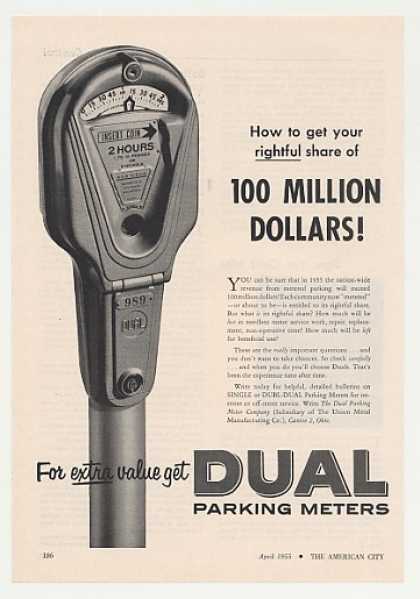
   By August of the same year, the Baltimore City Board of Estimates let its first of eventually two contracts for meters to the Duncan (Miller) Parking Meter Corporation of Chicago, IL which produced the first mechanical meters - the Dual Parking Meter Company produced the later automatic meters which operated at the insertion of a coin. The total cost of the original 2490 meters was $114,237.00.

Early Dual Parking Meter ad
  Under the administration of Mayor Thomas D'Alesandro, Jr. (father of Representative Nancy D'Alesandro Pelosi), the first parking meter in Baltimore was installed on North Avenue, followed by Charles Street by the 1st of November 1955. Others quickly followed on Eastern and Pennsylvania Avenues and near Cross Street Market. Closer to the Inner Harbor, the next set of meters were installed in Sam Smith Park, just off of the Pratt Street waterfront - according to a Baltimore Sun article, they had a "rate of a nickel an hour for private autos and 25 cents for two hours for semi-trailers."  By 1956, the Waverly and Highlandtown business districts were added to the city's collection due to the aggressive push of Henry A. Barnes, the City's traffic director at the time.

  Early disapprovals ensued between Federal and City officials as was indicted by a July 22, 1958 Baltimore Sun article that reported "not one red penny of funds from this office will be dropped into the city's new red parking meters on Government property, the U.S. marshal declared.  He was apparently miffed that the City had allotted space on Calvert Street near the Battle Monument for the "Federal Bureau of Investigation (4 spaces) and armed forces recruiting (6 spaces), but not one for the Federal marshal's cars."

(Note: Referenced article is courtesy of The Baltimore Sun) 

Saturday, February 2, 2013

Molasses and Stowaways at Domino Sugar

   Here in Baltimore, one can't help but notice the red, brightly illuminated, iconic Domino Sugar sign atop the sugar refinery building at night, located on the southeast section of the Inner Harbor.  In December, the Baltimore Sun heralded a photo contest sponsored by Domino Sugar to help celebrate its 90th birthday.  Some impressive photos of the sign atop this iconic building were submitted by contestants, judged by a panel of Domino Sugar judges - the winning photo is pictured below.
Photo Courtesy:  Don Vetter

  The Domino Sugar refinery building, one of a few on the east coast was built on a plot of land at the intersection of Beason and Jones Streets on Locust Point in South Baltimore. According to Baltimore Sun reports, the 1/4 mile waterfront location was originally planned for an immigration station but, in January 1920, it was purchased by the American Sugar Refining Company with plans to construct an $8 million plant that would have dock facilities to accommodate a total of four steamships.  

  Carl F. Huttlinger, the refinery's first superintendent who began his career at the Jersey City, NJ refinery facility and was later transferred to Baltimore, witnessed the first shipment which was reported on March 11, 1922 by the Baltimore Sun as carrying 724,936 gallons of crude molasses brought by the tanker Dulcino from Cuba.  On April 3, the refinery was open to begin processing the raw material and, within two days, dealers began receiving the refined sugar.   

Sugar cane harvested from New Orleans, circa 1910
  The raw material used as a foundation for refined sugar traditionally began as sugarcane or sugar beets which was shipped from Cuba, Puerto Rico (and later the Philippines).  During it's early operation, according to plant officials, from the time it was harvested and placed in burlap (as a solid) or liquified within ship containers, it did not touch human hands until it emerged as refined sugar. As reported by the Baltimore Sun, on December 11, 1924, the first shipment of sugar (31,000 bags) from Louisiana plantations arrived into Baltimore on the Domino, a ship in the company's fleet.  Ships would arrive at this dock with raw sugar up to several times monthly and have continued to be shipped to this day.

  Interestingly enough, by the mid-1980s the Domino Sugar sign welcomed immigrants to the America (in the same manner as the Statue of Liberty would in New York Harbor and as this waterfront land was once destined to do) when on August 14, 1986, the Baltimore Sun reported that "nine husky and uncooperative Columbian stowaways" attempted to illegally enter the U.S.  A U.S. Immigration and Naturalization Service official was quoted as saying "For spending 10 days at sea on water and sugar, they are extremely fit.  They are big, husky men."

An early Domino Sugar ad, circa 1900
  Nearly a year later, in October 1987, the Domino Sugar refinery docks hosted another ship laden with another crystalline substance - $7 million in nearly pure cocaine. According to the Baltimore Sun, the couriers were arrested only after having wandered around Baltimore with four kilos of cocaine under their jackets (one package of which was accidentally dropped by nervous crewmen along a street in the Mount Vernon Place area. A DEA spokesman stated in the article that it stayed there for several hours).

(Note: Article sources are courtesy of The Baltimore Sun.) 

Saturday, January 5, 2013

Knickerbocker Ice Company in Baltimore

    As I am a recent transplant from Manhattan to the Charm City, I thought that for my first blog entry, it was fitting to highlight a little bit of New York that was once a very important business in Baltimore.  As I was sightseeing with a friend from Toronto this holiday season, I was slightly perplexed to encounter a historical photograph of the Inner Harbor containing a historical remembrance of a now bygone company that was uniquely attributed to New York City.

    The Knickerbocker Ice Company, incorporated in 1855 and headquartered in New York City, operated in Manhattan from a pier at West 20th Street on the Hudson River as well as Washington, Philadelphia, and Baltimore during the period of 1895-1899.  Most of the natural ice during this time was 'harvested' from upstate New York east of Rockland Lake and brought by barge down the Hudson River to New York City where it was further distributed by either boat or train to its Philadelphia location.  This location controlled the natural ice output to southern cities such as Baltimore and Washington.  The years of 1890, 1906, and 1913 were extremely warm and caused equal extremes in price fluctuations and a great deal of public distrust and disgruntlement over the ice trade and access to this valuable commodity.

    In Baltimore, the Knickerbocker Ice Company was located in the Inner Harbor at the foot of Federal Hill (as visualized in the colorized postcard, above, and a black and white photograph circa 1906, right, courtesy of the Detroit Publishing Company). It owned several ice industry railroad tracks along the edge of Baltimore's Inner Harbor which were often leased to other local businesses.

    The Knickerbocker Ice Company (at large) was sold in 1896 and The Sun reported on July 7, 1899 that it was to be merged with the Consolidated Ice Company to form the American Ice Company.  As it turned out, the American Ice Company succeeded in attaining monopoly control of the market and the establishment of "the ice trust." According to a May 1933 Fortune article, "Water Still Freezes," within three years from the time the trust was estabilished, it would be on the brink of bankruptcy but successfully revitalized itself by the early1920s virtually all of its business was in manufactured ice.  By the early years of the twentieth century, refrigeration cooling systems and their "plant ice" replaced natural ice production such that this unique trade commodity became vastly less valued.

    While there are no visible signs of the Knickerbocker Ice Company in Baltimore to this day, it is interesting to note that the American Ice Company of Baltimore ice manufacturing plant (listed in both the National Register of Historic Places and the Maryland Historic Trust) can be found at 330 W23rd Street, Baltimore, Maryland.