Pages

Showing posts with label Baltimore City Council. Show all posts

Thursday, May 2, 2013

Baltimore’s Flower Mart – Roots from Civic Minds (1911)


This weekend, May 3 and 4, Baltimore will host what has been said to be America’s oldest garden show and it, the FlowerMart, will be 102 years old this go around.   While currently sponsored by the “Flower Mart at Mount Vernon, Ltd.”, a non-profit organization, the roots of this locally famous event can be traced to the ideas of some pretty impressive, civic-minded, early 20th Century women.

FlowerMart ad from
VisitMountVernon
  Baltimore at the time was well on the path of resurgence since the Great Fire of 1904, however there was no city plan with zoning protections, smoke permeated the air, and rebuilding took precedence over sanitization improvements that would have typified those of a modern city such as this.

  This was a city where by 1911, individual liberty trumped community welfare. The school system consisted of schools, many of which were built before the Civil War, needing upgrade and expansion to meet the expanding school-age population.   Overcrowding was leading to higher death rates, epidemics, and unhealthy supplies of food and staples, like milk. At this time, the population was composed of 20 percent African-American Baltimoreans who lived in some of the most deplorable of conditions.

Women's Civic League Seal
(ties to the Flower Mart location)
  To the rescue was the Women’s Civic League of Baltimore!!!  The Civic League was first organized in January 1911, the result of a meeting of six women who met in the home of Mr. and Mrs. Francis M. Jencks.  The By-Laws captured their noble purpose:
“To suggest, obtain, improve and promote desirable and proper living conditions in the City of Baltimore and its environs, or elsewhere in the State of Maryland, in respect to hygienic and sanitary matters, cleanliness, recreation, ornamentation, cultivation, the abatement of nuisances of every kind, and … whatsoever which may in any way effect the safety, health, or welfare of the people.”

  That first meeting determined that the League (and its Board of Directors, numbering 50) would be composed only of women, and Advisory Council of 55 men.  By 1916, they numbered 2,172 in membership.  They elected their first president; Mrs. Henry Barton Jacobs, and women on the first Board of Directors represented some of Baltimore’s most notable families. [The Frick family arrived around 1770 to Baltimore, had a family member on the first Baltimore City Council; the Gutmans and Hutzlers were two of Baltimore’s most well-known retailing families; and the Abell family were longtime owners of the Baltimore Sun]

  With thousands of members, they had a Committee to address just about everything, here is just a sampling:  Juniors Division, Milk, Health, Art, History, Citizenship, City Planning and Zoning, Civil Service, Education, and Home Garden Committee (to which we owe the idea of a Flower Market to be held around the Washington Monument as a means of raising funds for the work of the Committee, which originally as an idea in the mind of Miss Maria Manly).

Page from the Women's Civic
League membership brochure
  The women of the League, having much more time to spare on civic matters than the women of today, were able to claim an imposing list of achievements in Baltimore since its inception.  In 1911, the Home Garden Committee began the first flower mart, believed to be the first one in this country. In 1912, they asked the health department to abolish the sale of unbottled milk, publish milk scores, and set standards of bacteria for raw and pasteurized milk.

  As early as 1911, they called for inspections of smoke stack plants of the city that led to the Mayor appointing a Smoke Abatement Commission and inspector – a Smoke Abatement Ordinance was passed and signed in 1931. By 1945, an ordinance to prohibit the sale of wild rabbits, a source of tularemia, was supported. By 1955, the league drew up an ordinance that was passed by the City Council controlling the use of electric signs.
At the 1955 Flower Mart, the Red Rose was chosen by popular vote as the official flower of the City of Baltimore.  The helped bring about an Enoch Pratt branch library, cross-town service between North and East Baltimore, and many more successes.

  Within ten years just shy of a century of the Women’s Civic League, the Flower Mart was about to be cancelled for good due to the League’s dwindling membership, but you can read about how it survived even this challenge in a May 5, 2011 Baltimore Sun article.  So, as you experience the tradition this weekend,…remember and be thankful for the convictions and enthusiasm of some very special women from an earlier generation.

(Source: “History of the Women’s Civic League of Baltimore, 1911-1961", King Brothers Inc., and the Baltimore Sun)

Sunday, March 31, 2013

The Lasting Products Company - Baltimore City's "Little Castles"

The Lasting Products Company ad, circa 1946

Until 1937, downtown Baltimore City homes looked like many other homes within urban landscapes across America - concrete or brick-faced or even slated wood - but U.S. Patent Number 2,095,641 would change all that.  Lewis Albert Knight (he went by "Albert") had a vision which eventually transformed the traditional row home-lined Baltimore City street only to become a distinctive part of its unique heritage. Mr. Knight graduated from Franklin High School in Reisterstown, studied at the Maryland Institute, and eventually received his bachelor's degree from Johns Hopkins University.  He died in 1980 at the age of 76.

  On March 1, 1937, this Glyndon native filed his patent as an assignor to the Lasting Products Company where he was employed at the time - "A process of making artificial stone wall facings."  It was marketed to thousands of homeowners that it would "make your home the neighborhood showplace," "beautiful, long-lasting," and "maintenance free."

The FormStone Original, PlateMarker
  The parent firm of Formstone was the Lasting Products Company (see their ad, above), a paint manufacturing firm founded by Albert I. Rankin who was born in 1897 and immigrated to Baltimore as a young boy.  He began manufacturing paint, roof coatings, and putty at 200-212 S. Franklintown Rd, Baltimore, MD, the location of the company until it sold out in 1974, seven years after he died.

  Simulated stone was found in other cities, and while the Formstone patent expired 17 years later, it went by a multitude of other brands such as "Perma-stone," "Dixie Stone,""Rostone," "Silverstone," TruStone,""Bermuda Stone,"Modern Stone," "Romanstone," "Magnolia Stone," "Fieldstone," or "Stone of Ages."  It was the rage throughout the 40s, 50s, and 60s, given that homeowners seemed to love it as it covered up brick and other masonry imperfections, helped modernize home appearances, and was advertised to be near maintenance-free. Those who dreaded the idea of repeated, exterior wall painting, saw hope in the concept.

"Little Castles" Rowhomes in Baltimore
(Photo: Courtesy, theatlanticcity.com)
  Formstone and Permastone were similar in that they were created at the job site, much like interior plaster.   Decades later, there were surprises for homeowners and a nightmare for preservationists since its removal would often destroy the original detailing under the installation.  Mesh wiring was first applied to the exterior of the building, overlaid by a cement "scratch" coat.  Over that went a base coat followed by a color or textured material that was hand-sculptured on top - in Mr. Knight's case, rather than just coloring the stone mixture with pigment, he mixed colored stones from many parts of the country which enabled it to be color-resistant to outdoor elements.

  According to "Old House Journal, 1982," Formstone was not the only affront to be sprayed, rolled, poured, or smeared over original exteriors.  For instance, there was the "Merit Wall Method"which was marketed by Merit Enterprises.  A thick rubbery material was sprayed over everything but the window glass -- cornices, gutters, and door frames were not exempted. Suspended in goo was fine stone dust and the effect was that of a huge metalflake balloon having been stretched over the house and then cut out at the doors and windows."  Fortunately, it never caught on to the extent of Formstone.

  Native son and avant-garde film director, John Waters, affectionately referred to it as the "Polyester of Brick" and went so far as to document it in one entitled "Little Castles: A Formstone Phenomenon."  Due to its prolific use in over 50 percent of Baltimore row homes, preservationists to this day debate over what is worthy of preservation - the pre-faux or the post-faux look. The idea of preserving Formstone in Baltimore has been creeping into the modernist mentality, while others have decided that tradition is what lies beneath.  A Baltimore Sun article, December 1, 2012, states that the Baltimore City Council seems to be of the impression that it is a rather tacky appearance and needs to henceforth be banned from further proliferation and use.  What opinion do you have, hon?

Wednesday, March 6, 2013

Celebrating the Marvels of Light at 39 West Lexington


1916 Old BG&E Building,
Gas Light Panel
(Courtesy: Anomalous_A,
Flickr.com)
  Early Baltimore Gas and Electric History - On March 11, 1802, the Federal Gazette & Baltimore Daily Advertiser reported on a “new light,” the invention of a young scientist named Benjamin Henfrey, being demonstrated as gaslights – it was a novelty, but gained no financial support at first.  It would take several years until Dr. Charles Kugler, a Philadelphia merchant, in an effort to bring his gas manufacturing techniques to public attention, convinced Rembrandt Peale to illuminate a room on June 11, 1816 in his Peale Museum (also known as the Municipal Museum of the City of Baltimore, 225 N. Holliday Street) with burning gas lamps.

  The public was so impressed that, by June 14th, 1816, a small group of men convinced by the demonstrations formed the Gas Light Company of Baltimore (the earliest predecessor of today’s Baltimore Gas and Electric (BG&E)) and petitioned the Mayor and the Baltimore City Council with a plan to begin lighting some of the city streets.  Franchise rights were granted along with a contract.  On December 2nd of that year, the General Assembly of Maryland approved the incorporation of the first gas company in the New World. 

  In 1888, rival gas companies merged into the Consolidated Gas Company of Baltimore. Several years earlier, in 1879, Thomas Edison demonstrated his incandescent lamp in Menlo Park, NJ that heralded a new era in light.  While the first electric company in Baltimore was the Brush Electric Light Company, incorporated in 1881, the United Electric Light and Power Company was the primary electric service provider for Baltimore.  When they joined in 1906 with Consolidated Gas to become Consolidated Gas Electric Light and Power Company of Baltimore, it became the city’s first fully integrated gas and electric company.
Gas Electric Company,
NW Corner, Liberty
& Lexington, c1906

  In 1915, the integration was by name only and buildings were not only dispersed around the city but the electric division was separate from the gas division.  In leased locations were The House Electric was at a building on 325 North Charles Street, the legal and claims department was in the Title Building, the gas industrial fuel department was at the corner of Saratoga Street and Park Avenue, the electric office was at the Continental Building (near Calvert and Baltimore Streets). The one owned building on the opposite corner of Liberty and Lexington Streets (shown, left) housed the headquarters of the gas division executive, bookkeeping and accounting offices, and sales and commercial departments.  Consolidation would become a reality.

Prior to the Lexington Building
SE Corner, Liberty & Lexington, c1915
 Negotiations began nine years after Baltimore’s Great Fire for the property at the southeast corner of Liberty and Lexington Streets and what was Little Sharp Street (see photo of the site prior to construction, right). On Feb 24, 1915, the Baltimore Sun reported that Boston architect Parker, Thomas & Rice would design the new office building to be erected by J. Henry Miller, Inc. at what is now 39 West Lexington Street to house its corporate leadership and possibly the Pennsylvania Water and Power Company.  Mr. Miller had also built Union Station in Baltimore.

  While construction progressed, on June 16 and 17, 1916, the company celebrated the American Gas Centenary as it was publicized throughout the country, distinguished scientists and engineers gathered in Baltimore for events surrounding the celebration with great fanfare.  On the first day, City Hall’s great bell pealed 100 times (one for each year since Peale added gas illumination to Baltimore Museum exhibits) followed by a four-mile, two hour long, parade in which 2,500 employees marched along with over 10 bands, 200 horses, and 52 decorated floats (some were 40 feet long) depicting among other themes – “The Evolution of Light”, “ The Evolution of Power”, “The Industrial Growth of Baltimore”, and “Household Economics.”  Nothing like it had ever been seen in Baltimore before.
Early Lexington Building photo
circa 1925

View of the Lexington
Building, from present
Liberty Dog Run, c1920
  In December 1916, the new Lexington Building (later to be renamed the Gas and Electric Building) was occupied.  It was built of granite and terra-cotta layered between floors upon a steel structure.  The entire basement, mezzanine, second and third floors were used for showrooms and retail shops highlighting gas and electric appliances and ornamentals of the day (see photos, below). It boasted eight high-speed elevators, filtered water and fountains on each floor as well as hot and cold washstands.

50 Kilowatt Lightbulb,
redisplayed in 1939
  Interestingly enough, it was on the roof of the 39 West Lex building that in order to mark the fiftieth anniversary of Thomas Edison’s invention of his incandescent lamp, for the week of October 14-21, 1929, the largest incandescent light bulb in the world at the time was illuminated – 50 kilowatts!  According to the Sun, “the bulb is 20 inches in diameter.  Its output approximately 1,400,000 lumens.” 

Early BG&E sales room,
39 West Lexington Building,
1st Floor, c1950s
  The building continued to be used for sales showrooms and as BG&E's headquarters throughout the 2000s (see photos, left).  It was placed on the National Register of Historic places and, under guidance by the National Park Service, preserved and restored as it was sold by BG&E to Southern Management Corporation for use as luxury apartments.


(Sources: “A History of Consolidated Gas Electric Light and Power Company of Baltimore, by Thomson King, 1950” and Baltimore Sun Articles)
(Photos: Courtesy of Southern Management Corporation, 39 West Lex; Thomas King book; and Flickr.com)

Tuesday, February 12, 2013

The Baltimore General Dispensary (1801-1959)


  While public opinion of our current health system and Obamacare is still being deliberated, there was such a time when there were Free Dispensaries connected with every College. At one point in Baltimore history, there were also four City Dispensaries where patients received medical aid in Baltimore free of charge and were often visited at their homes by the Dispensary physicians.  Over the 158 years of Baltimore's oldest charity operation, the Baltimore General Dispensary treated a total of 950,310 patients and filled over 1.5 million prescriptions.

Original 1801Location:
127 E. Baltimore Street
  On February 10, 1801, at the old Indian Queen Tavern, which was on the corner of Hanover and Baltimore Streets (currently where the Morris Mechanic Theater sits), a few generous and kindhearted gentlemen had a zeal for the welfare of the poor.  Seeing that there was no organized system of relief, they got together to form by-laws.  Three other meetings transpired that month after which the original consulting and attending physicians and apothecary were assigned.  It endeavored to alleviate the sufferings of the sick and poor, “whether Presbyterian, Methodist, Catholic or Jew.”

  A search of the records of the Maryland Historical Society revealed an old painting showing Baltimore Street looking west from Calvert Street and the first home (1801 to 1803) of the Baltimore General Dispensary at No. 127 E. Baltimore Street on the southeast corner of Public Alley (now Grant Street).

  According to the History of the Baltimore General Dispensary, the first case was recorded as being on April 1, 1801 and a total of 300 patients were treated the first year.  In 1802, the hours were 8am to 2pm and 3pm to 6pm every day such that “every case shall be duly attended, whether acute, chronic, surgical, or obstetric” by physicians who were salaried at $300 per year in 1803.

651 W. Lexington St, 1893
  The Dispensary moved to a house on Light Street for several months and then again in October 1803 to a house on Chatham (now Fayette) Street between Charles Street and St. Paul Lane.

  What began as a mere charity, in 1807 the Baltimore General Dispensary proposed to the Maryland General Assembly that it be incorporated and became the third charted institution in the State of Maryland, only to be preceded by the Equitable Fire Insurance Company and the Bank of Baltimore.

  On Dec 7, 1837, the Dispensary moved to a rented house on the northeast corner of Liberty and Fayette Streets (it later built a three story building there in June 1875) where it dutifully provided services until 1893.

500 W. Fayette Street (Photo: Courtesy, Wikipedia)
  In 1893, the Baltimore General Dispensary moved to a house it purchased at 651 W. Lexington Street. By 1900, the City Charter contained provisions giving the mayor and the City Council power to make contracts with it and other dispensaries around the city.

  The Lexington Street property was sold for the purchase of a dwelling on the northwest corner of Paca and Fayette Streets.  The building standing today, shown at right, was architected by Geroge Norbury Mackenzie III, built in 1911, and on Feb 15, 1912 received its first patients until it closed in 1958.  The work of the Baltimore General Dispensary Foundation, while not currently conducted within a building, continues to this day through funds to area hospitals for medicine in their outpatient departments.  

(Source: "A History of the Baltimore General Dispensary", 1963, Baltimore General Dispensary Foundation, Inc. )

Saturday, February 9, 2013

The Struggle for Baltimore's First Parking Meters

Parisian women in 1960, not Baltimore, hon.
  To look at the prolific distribution of parking meters across the City of Baltimore, one might think that they've been there near the time of the earliest automobile.  It turns out that the Baltimore City Council first took up the suggestion of installing meters in the Summer of 1937, only to banter about it for close to two decades.

  Baltimore's traffic problem began to annoy city traffic officials by the mid 20's and they had been hearing of the success these devices brought many other cities across America - the first in the U.S., according to "thexpiredmeter.com" was installed in downtown Oklahoma City, OK produced by the Magee-Hale Park-O-Meter Company.

  It became a nearly perennial occurrence that some bill came to the City Council over the 18 years until in February 1955 when it was reported by the Baltimore Sun that it had "adopted a favorable report on a bill authorizing the installation of almost 3,000 parking meters on about 40 business streets."

Duncan-Miller Parking Meter, c1955
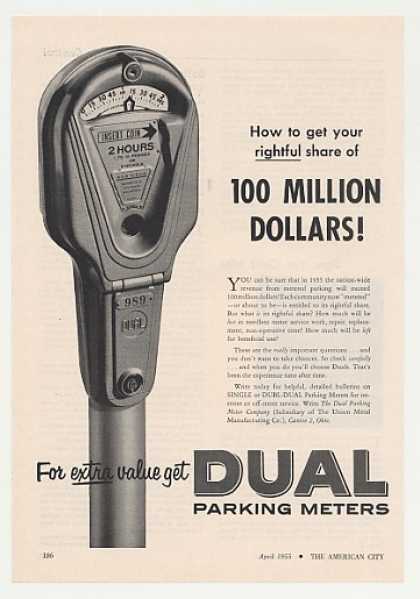
   By August of the same year, the Baltimore City Board of Estimates let its first of eventually two contracts for meters to the Duncan (Miller) Parking Meter Corporation of Chicago, IL which produced the first mechanical meters - the Dual Parking Meter Company produced the later automatic meters which operated at the insertion of a coin. The total cost of the original 2490 meters was $114,237.00.

Early Dual Parking Meter ad
  Under the administration of Mayor Thomas D'Alesandro, Jr. (father of Representative Nancy D'Alesandro Pelosi), the first parking meter in Baltimore was installed on North Avenue, followed by Charles Street by the 1st of November 1955. Others quickly followed on Eastern and Pennsylvania Avenues and near Cross Street Market. Closer to the Inner Harbor, the next set of meters were installed in Sam Smith Park, just off of the Pratt Street waterfront - according to a Baltimore Sun article, they had a "rate of a nickel an hour for private autos and 25 cents for two hours for semi-trailers."  By 1956, the Waverly and Highlandtown business districts were added to the city's collection due to the aggressive push of Henry A. Barnes, the City's traffic director at the time.

  Early disapprovals ensued between Federal and City officials as was indicted by a July 22, 1958 Baltimore Sun article that reported "not one red penny of funds from this office will be dropped into the city's new red parking meters on Government property, the U.S. marshal declared.  He was apparently miffed that the City had allotted space on Calvert Street near the Battle Monument for the "Federal Bureau of Investigation (4 spaces) and armed forces recruiting (6 spaces), but not one for the Federal marshal's cars."

(Note: Referenced article is courtesy of The Baltimore Sun)